

A real case from Orange Grove Vet highlights why sterilisation is about much more than preventing unwanted litters.
As pet owners, we want to believe that our dogs and cats will stay healthy simply because they seem well. But some serious conditions can develop quietly before suddenly becoming a medical emergency.
A recent case at Orange Grove Vet is a powerful example.
A 3-year-old female dog who had not been sterilised was brought to the practice with diarrhoea, gastrointestinal symptoms and a low-grade fever.
Initially, the signs did not immediately point to a life-threatening reproductive emergency.
But when the dog failed to improve, further investigation revealed something much more serious.
From gastrointestinal symptoms to an emergency
The dog was initially tested for Giardia and treated with antibiotics and medication to manage her symptoms. Her owners were instructed to bring her back to Orange Grove Vet 24 hours later for a re-check.
When they returned the following day, there had been very little improvement.
The veterinary team decided that further investigation was necessary. Additional blood tests were performed, followed by X-rays.
The results raised concern about a potentially life-threatening condition.
The veterinary team suspected pyometra.
The patient was rushed into surgery, where Dr Romberg, assisted by Dr Mannix, performed an emergency hysterectomy.
Unfortunately, this was not a routine sterilisation procedure.
The dog had developed a closed pyometra, in which infected material and pus had become trapped inside the uterus.
She required six days of intensive hospital care to ensure the infection was brought under control before she could return home.
Thankfully, she was able to leave the hospital and continue her recovery at home. ❤️🐾
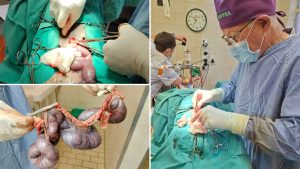
Caption: Drs Romberg and Mannix performing an emergency surgery to remove the pyometra (pus filled uterus).
What is pyometra?
Pyometra is a serious bacterial infection of the uterus that occurs in unsterilised female dogs.
Hormonal changes following a heat cycle can cause changes to the lining of the uterus. These changes can create an environment where bacteria can multiply and infection develops. Pyometra is more common in older dogs, but younger unsterilised dogs can also develop the condition. Merck Veterinary Manual
There are two forms of pyometra:
Open pyometra
In an open pyometra, the cervix remains open and infected material can drain through the vagina.
Pet owners may notice:
- Pus-like or bloody vaginal discharge
- Lethargy
- Loss of appetite
- Increased thirst
- Increased urination
- Vomiting
- Fever
Closed pyometra
A closed pyometra can be particularly dangerous.
The cervix is closed, meaning that the infected material cannot drain from the uterus. Instead, pus and fluid continue to accumulate inside the uterus.
The abdomen may become enlarged or painful, and the dog can become severely ill.
Most importantly, there may be no vaginal discharge at all.
This means that owners may not realise that their dog has a serious uterine infection until she is already very sick. Closed pyometra can progress rapidly and can lead to severe systemic infection, shock, uterine rupture and death if not treated promptly. Merck Veterinary Manual
What are the warning signs?
Pyometra doesn’t always look the same in every dog.
Signs can include:
🐾 Lethargy or weakness
🐾 Loss of appetite
🐾 Increased thirst and urination
🐾 Vomiting or diarrhoea
🐾 Fever
🐾 Abdominal pain or enlargement
🐾 Vaginal discharge
Some dogs may initially show relatively nonspecific symptoms, which can make diagnosis challenging.
That’s why any unsterilised female dog that becomes unwell should be assessed by a veterinarian, particularly if she has recently been through a heat cycle. ACVS
How is pyometra diagnosed?
Your veterinarian may recommend several tests depending on your pet’s symptoms and physical examination.
These can include:
- Blood tests
- X-rays
- Ultrasound
- Urine testing
- Other diagnostic tests as required
X-rays may show an enlarged uterus, while ultrasound can help identify a fluid-filled uterus and distinguish pyometra from other conditions. ACVS
In the case of the Orange Grove Vet patient, further blood tests and X-rays helped the veterinary team identify the potentially life-threatening problem and act quickly.
Why is pyometra an emergency?
Pyometra is not simply a “uterine infection”.
As the infection progresses, bacteria and their toxins can affect the entire body. Dogs can become severely dehydrated and develop systemic infection, kidney problems, sepsis and other complications.
In a closed pyometra, there is also a risk that the enlarged, infected uterus can rupture, releasing infected material into the abdominal cavity.
This is why rapid veterinary treatment is so important. ACVS
Treatment for most dogs with pyometra involves stabilising the patient and surgically removing the infected uterus and ovaries through an ovariohysterectomy (spay). Surgery for pyometra is more complicated than a routine sterilisation because the uterus may be enlarged, fragile and infected. ACVS
Could sterilisation have prevented this?
Yes.
Spaying a female dog involves removing the ovaries and uterus, depending on the surgical technique used.
Because the uterus is removed, a spayed female dog cannot develop pyometra. Vca
This is one of the most important health benefits of sterilisation.
A planned sterilisation procedure is also very different from emergency surgery on a critically ill patient with an infected uterus.
A routine procedure allows your veterinary team to assess your pet beforehand and plan appropriate anaesthesia, surgery and aftercare.
An emergency pyometra surgery may involve a patient who is already dehydrated, infected or systemically unwell.
Prevention can be considerably safer than waiting for an emergency.
Other benefits of sterilising your pet
Sterilisation isn’t only about preventing unwanted puppies and kittens.
For female dogs
Spaying can:
- Prevent pyometra
- Prevent unwanted pregnancies
- Eliminate diseases of the uterus and ovaries
- Eliminate heat cycles
- Reduce the risk of mammary tumours when performed at an appropriate age
The timing of spaying is an individual decision. Factors such as breed, adult size, age, lifestyle and overall health should be discussed with your veterinarian. Vca
For male dogs
Neutering can:
- Prevent unwanted litters
- Eliminate the risk of testicular cancer
- Reduce the risk of some prostate problems
- Reduce some hormone-driven behaviours in certain dogs
Your veterinarian can discuss the potential benefits and risks for your individual pet.
Sterilisation is an individual decision
There is no single answer for every dog.
Some factors may influence when your pet should be sterilised, including breed, size, age, health, lifestyle and whether the pet is intended for responsible breeding.
That’s why it’s important to have a conversation with your veterinarian rather than relying on a one-size-fits-all recommendation.
The important thing is to understand the potential risks of leaving a female dog unsterilised — including the risk of pyometra.
Don’t wait until your pet is seriously ill
The dog in this case was only 3 years old.
Her initial symptoms looked like a gastrointestinal problem, but further investigation revealed a serious reproductive emergency.
Her story is a reminder that pyometra can affect younger unsterilised dogs and may initially present with nonspecific signs.
And with a closed pyometra, there may be no obvious discharge to alert an owner that something is wrong.
If your unsterilised female dog becomes lethargic, stops eating, develops vomiting or diarrhoea, drinks excessively, develops abdominal swelling or simply seems unwell, contact your veterinarian promptly.
If your pet has not yet been sterilised, speak to your veterinary team about whether sterilisation is appropriate and what timing is best for your individual pet.
❤️ Prevention starts with a conversation.
At Orange Grove Vet, our goal is to help you make informed decisions about your pet’s health and wellbeing — from preventative healthcare and routine sterilisation to emergency veterinary care when your pet needs us most.
If you’re unsure whether it’s time to sterilise your pet, talk to our veterinary team.


